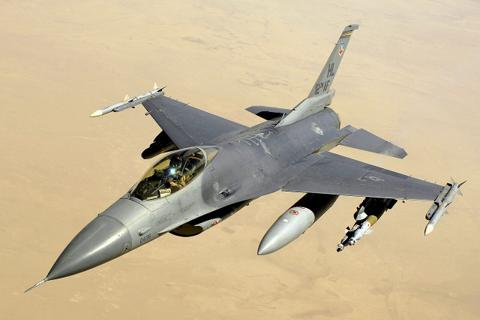
The world's first operational vertical take-off 'jump jet'. Built around the Rolls-Royce Pegasus engine and its four rotating exhaust nozzles, it can hover, fly backwards and, in combat, vector its nozzles in forward flight to force a pursuing fighter to overshoot. Developed by Hawker Siddeley.
The world's first operational vertical take-off 'jump jet'. Developed by Hawker Siddeley.
 Photo: Anthony Noble, GNU Free Documentation License, Version 1.2
See Specifications for full detail.
The Harrier is a British single-engine vertical/short take-off and landing (V/STOL) jet fighter developed by Hawker Siddeley, later British Aerospace. A single vectored-thrust turbofan with four swivelling nozzles lets it take off and land vertically or from very short strips.[1]
For nearly six decades it was the only successful VTOL combat aircraft fielded in the West, flying from jungle clearings, small ship decks and roads. The Sea Harrier fought in the 1982 Falklands War, and the US Marine Corps' AV-8B variant remained in service until its retirement in June 2026.[2]
NATO planners in the 1950s assumed Warsaw Pact strikes would crater every runway in Europe within the war's first hours, grounding conventional air forces intact. That assumption drove the requirement for a fighter that needed no runway at all.[1]
French engineer Michel Wibault's idea of vectoring engine thrust through rotating nozzles found its way to Bristol's Stanley Hooker, who shaped it into the Pegasus engine, and to Hawker's Sydney Camm - designer of the Hurricane - who wrapped the P.1127 airframe around it. The P.1127 hovered in October 1960, tethered and wobbling; the evaluation Kestrel and, from 1966, the production Harrier GR.1 followed.[1]
The RAF fielded the world's first operational VTOL combat squadron in 1969, and the concept immediately found its second home: ships. The Sea Harrier of 1980 added radar and Sidewinders for the Royal Navy's small carriers, whose ski-jump bows let Harriers launch heavy and land vertically - a template the world's navies still copy.[3]
The U.S. Marines, uniquely among American services, bought a foreign fighter almost off the shelf as the AV-8A - then partnered with McDonnell Douglas and British Aerospace to rebuild it as the AV-8B Harrier II of the 1980s: bigger composite wing, double the payload, and the definitive expression of the breed, serving the Marines, Spain and Italy for four decades.[4]
The Pegasus is the whole trick: one engine, four nozzles - two blowing cool fan air forward of the centre of gravity, two blowing hot exhaust behind it - rotating together through 98.5 degrees. Point them back and the Harrier is a jet; point them down and 21,500 pounds of thrust becomes a hovering platform; point them somewhere between and you get short rolling takeoffs with full warloads.[1]
In combat the nozzles yielded VIFF - 'vectoring in forward flight' - letting a Harrier brake and pivot mid-dogfight in ways nothing else could answer. The price was a reputation as the most unforgiving jet in Western service: hovering on four columns of thrust with puffer-jet controls at each extremity demanded helicopter skills at fighter stakes, and the accident rate showed it.[4]
The Falklands War of 1982 was the Harrier's vindication: the only fixed-wing air cover Britain could bring 8,000 miles south flew from two small carriers, and the Sea Harrier's combination of VIFF agility, AIM-9L missiles and superb pilots swept the sky - 20+ kills, none lost in air combat. RAF GR.3s flew ground attack alongside; a war without runways was won by the jet that didn't need one.[3]
Marine AV-8Bs made the concept expeditionary doctrine: Desert Storm from amphibious ships and forward pads, Iraq, Afghanistan (including responding when the Taliban's 2012 Camp Bastion raid destroyed six on the ground - the worst U.S. air-loss day since Vietnam), Libya, and strikes against ISIS and Houthi targets into the 2020s.[4]
The long goodbye ran in stages: the Sea Harrier retired in 2006, Britain's Harrier force fell to austerity in 2010 (its jets sold to the U.S. as spares), Spain and Italy transitioned to F-35Bs - and on 3 June 2026, VMA-223 'Bulldogs' flew the U.S. Marine Corps' final AV-8B sortie at Cherry Point, closing Western VTOL's first chapter 66 years after the P.1127 first wobbled into a hover.[2][5]
Every F-35B that lands vertically on a small deck anywhere in the world is executing the Harrier's idea with new technology - its lift fan and swivelling nozzle are direct descendants, and the ski-jump carriers built for Harriers now host their successor. The niche the P.1127 invented turned out to be permanent.[1]
The Harrier became a fixture of airshow displays for manoeuvres no other fixed-wing fighter could replicate, including the mid-air 'bow' and hovering sideways slide.[1]
Fully retired from military service worldwide since 2006 (and long before that in RAF/USMC front-line use), the original Hawker Siddeley Harrier does not appear in normal operation on Flightradar24; the only 'flying' examples left are museum static-display or occasional hover/taxi demonstrators at airshows.
| Performance | |
| Max Speed | 635 kn (731 mph / 1,176 km/h) |
|---|---|
| Cruise SpeedCruise Speed — The economical speed an aircraft sustains for the bulk of a flight - lower than maximum speed, chosen for the best balance of time and fuel burn. Glossary → | ~550-575 mph high-subsonic cruise |
| RangeRange — How far an aircraft can fly without refuelling. Quoted figures vary with payload, speed and reserves - see also ferry range and combat radius. Glossary → | 414 mi hi-lo-hi combat radius; up to 2,130 mi ferry range with external tanks |
| Service CeilingService Ceiling — The highest altitude at which an aircraft can still climb at a useful rate (typically 100 ft/min). Above it, the air is too thin to keep climbing meaningfully. Glossary → | 51,200 ft |
| Airframe & Weight | |
| Wingspan | 25 ft 3 in |
| Length | 46 ft 10 in |
| Height | 11 ft 11 in |
| WeightMTOW — Maximum Take-Off Weight - the heaviest an aircraft is certified to be at the start of its take-off run, including fuel, crew, payload and the aircraft itself. Glossary → | empty: 13,535 lb; MTOW: 25,200 lb |
| Power & Payload | |
| Engines | 1 x Rolls-Royce Pegasus 103 vectored-thrust turbofan (21,500 lbf with water injection) |
| ArmamentArmament — The weapons an aircraft can carry: guns, missiles, bombs and rockets, whether mounted internally, on wing hardpoints, or in bomb bays. Glossary → | 2 x 30 mm ADEN cannon pods; up to 5,000 lb of bombs, rockets or AIM-9 Sidewinder missiles across 5 external hardpoints |
| Crew | 1 (pilot); two-seat T.2/T.4 trainer variants carried 2 |
| CapacityPayload — Everything an aircraft is carrying that isn't the aircraft or its fuel: passengers, cargo, or weapons. Payload and fuel usually trade off against each other. Glossary → | N/A - single-seat attack aircraft; 5 external hardpoints for stores |
| Program & Service | |
| Manufacturer | Hawker Siddeley |
| Origin | United Kingdom |
| First Flight | December 28th 1967 |
| Service Entry | April 18th 1969 |
| Retired | November 1st 2006 |
| Number Built | 278 |
| Unit Cost | ~$5-6M (early-1970s USD, approximate AV-8A procurement cost; RAF GR3 unit cost was roughly £1-2M in period sterling) - roughly $44M in 2026 dollars, adjusted for CPI inflation |
5 notable events involving the Harrier, 1982 to 2019, accounting for 15 deaths. Curated rather than exhaustive.
During a bombing raid on Goose Green in the Falklands War, a Sea Harrier was hit by 35mm anti-aircraft fire, lost a wing, caught fire and crashed. The pilot, Lt Nick Taylor, was killed.
Two Sea Harriers launched from HMS Invincible on a combat air patrol in bad weather and never returned; they are presumed to have collided. Both pilots were lost.
An Exocet missile sank the container ship supporting the Falklands Harrier force, destroying six Wessex and three Chinook helicopters and vital stores. The Harriers already flown off to Hermes and Invincible fought on, latterly from a crude forward strip of metal planking at San Carlos.
A Taliban rocket strike on Kandahar Airfield destroyed one RAF Harrier GR7 and damaged another on the ground - the most serious materiel loss of the RAF's five-year Harrier deployment to Afghanistan.
A U.S. Marine Corps AV-8B Harrier crashed near Havelock, North Carolina, outside MCAS Cherry Point. The pilot ejected safely.
| GR.1 | Initial 1969 RAF production version, the world's first operational vertical take-off strike aircraft. |
| GR.3 | Improved mid-1970s RAF standard with a laser rangefinder nose, radar warning receiver and the uprated Pegasus 103 engine; the mark that fought in the Falklands War. |
| AV-8A / AV-8C | US Marine Corps export version bought from 1971 to give amphibious forces organic close air support without a runway. |
| Sea Harrier FRS.1 | Royal Navy carrier-based fighter/reconnaissance/strike variant with a raised cockpit and Blue Fox radar; the Fleet Air Arm's principal fixed-wing fighter in the 1982 Falklands War. |
| AV-8S Matador | Export version supplied to the Spanish Navy from 1976 and later transferred to the Royal Thai Navy, the last operator of any first-generation Harrier. |
| T.2 / T.4 / TAV-8A | Two-seat operational conversion trainers for the RAF and USMC. |

Source: FlightGlobal
Source: Stars and Stripes
Numbered as cited in the Overview article. Click a reference to see where it's used.
Additional reading you might find interesting...
PlanesDB entries are living documents - this is how this one has evolved, and who helped make it happen. Spotted something out of date? Help update it.