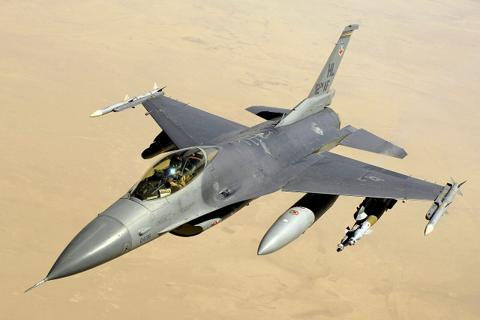
The F-5 is a family of small, twin-engine supersonic fighters built by Northrop, sold abroad in large numbers and also used by the US as an adversary trainer. The F-5E Tiger II first flew on 11th August 1972, and the family of F-5 and T-38 aircraft has passed 3,800 built. Developed by Northrop.
The F-5 is a family of small, twin-engine supersonic fighters built by Northrop, sold abroad in large numbers and also used by the US as an adversary trainer. Developed by Northrop.

See Specifications for full detail.
The F-5 is a small twin-engine fighter built by Northrop to be cheap to buy and easy to keep flying. The F-5A entered service on 30th April 1964, the improved F-5E Tiger II first flew on 11th August 1972, and between them the F-5 and its T-38 trainer cousin have passed 3,800 aircraft.[1]
Its second life began in 1975, when American pilots flew Tiger IIs painted as Soviet fighters to train against.[1]
Northrop's N-156 first flew on 30th July 1959 and the F-5A was selected on 23rd April 1962. The aim was an export fighter for allies that could not afford the best American aircraft. It had two J85 engines, and the first service aircraft arrived on 30th April 1964. About 1,204 F-5A and F-5B were built.[1]
The F-5E won the International Fighter Aircraft competition in 1970 and first flew on 11th August 1972. Its changes were the more powerful J85-GE-21 engines, an enlarged leading-edge root extension, a longer fuselage, Emerson AN/APQ-153 radar and a two-position nose gear. The first aircraft reached the 425th Tactical Fighter Squadron on 6th April 1973, and the F-5F two-seater flew on 25th September 1974.[1]
In 1965 the Air Force formed the 4503rd Tactical Fighter Squadron (Provisional) at Williams on 22nd July and sent 12 F-5As to South Vietnam. They left on 22nd October and reached Bien Hoa four days later. The trial ended on 9th March 1966 after about 2,600 sorties, with 2,093 flown from Bien Hoa and 571 from Da Nang over 3,116 combat hours.[1]
One aircraft was lost, killing Major Joe Baggett, and nine F-5s were lost in Vietnam in all. The unit became the 10th Fighter Commando Squadron. The Air Force did not adopt the F-5 as its own front-line fighter, but South Vietnam received about 158 F-5A and later models.[1]
From 1975 to 1990 the Air Force flew F-5Es as aggressors: the 64th and 65th Aggressor Squadrons at Nellis, the 527th at Alconbury and the 26th at Clark. US Navy TOPGUN flew them too, and in 2006 the Navy bought 36 ex-Swiss aircraft as F-5N and F-5F. VFC-111 flies 18 of them.[1]
Iran had 127 F-5A and F-5B by 1972 and about 181 F-5E, F-5F and RF-5A by 1976. South Korea had 340 in total, Saudi Arabia 139 across several variants, Taiwan 115 F-5A and F-5B plus 308 built locally, and Norway 108. The Netherlands flew 75 NF-5A and 30 NF-5B. The F-20 Tigershark, Northrop's improved version, lost its export sales to the F-16.[1]
The Ogaden War of 1977 produced the F-5's cleanest record. On 17th July 1977, two Ethiopian F-5s shot down two MiG-21s near Harer, and Legesse Tefera is credited with six or seven kills. In the Iran-Iraq war a claim was made on 6th August 1983 by Major Yadollah Javadpour of a MiG-25 kill, which is disputed.[1]
The type fought in Yemen in 1994, and Morocco lost 15 F-5s in the Western Sahara War. Israel said it destroyed two Iranian F-5s at Dezful in June 2025 and two at Tabriz in March 2026. In the ACEVAL and AIMVAL trials of 1977 the F-14 did slightly better than 2 to 1 against the F-5, though sources conflict on the numbers.[1]
Taiwan retired its F-5Es in November 2023 and the F-5F and RF-5E in July 2025. Switzerland sent 22 aircraft to the US from March 2024, and the Philippines retired the type in 2005 and Singapore by 2015. Brazil still flies 35 F-5EM and 4 F-5FM.[1]
The F-5's weaknesses showed up in sales and in losses. The F-20 Tigershark lost its export customers to the F-16, Morocco lost 15 F-5s in the Western Sahara War, and the ACEVAL and AIMVAL trials of 1977 showed the F-14 well ahead of it.[1]
The Northrop F-5E/F Tiger II has a top speed of 912 kn (1,050 mph / 1,690 km/h, Mach 1.63).
A total of 2,603 were built.
Yes, the Northrop F-5E/F Tiger II is still in service.
The Northrop F-5E/F Tiger II first flew on August 11th 1972.
The Northrop F-5E/F Tiger II has a range of 2,300 mi (3,701 km) with external tanks (Hill AFB); 1,590 mi on another source.
F-5s are preserved in museums on four continents, from Nellis Air Force Base to Ho Chi Minh City.
Civil adversary and military F-5s fly widely, but military flights are often hidden from public trackers. Look at Nellis Air Force Base, Naval Air Station Key West and Swiss and Brazilian bases around exercise dates.
| Performance | |
| Max Speed | 912 kn (1,050 mph / 1,690 km/h, Mach 1.63) |
|---|---|
| Cruise SpeedCruise Speed — The economical speed an aircraft sustains for the bulk of a flight - lower than maximum speed, chosen for the best balance of time and fuel burn. Glossary → | Not published in the sources checked |
| RangeRange — How far an aircraft can fly without refuelling. Quoted figures vary with payload, speed and reserves - see also ferry range and combat radius. Glossary → | 2,300 mi with external tanks (Hill AFB); 1,590 mi on another source |
| Service CeilingService Ceiling — The highest altitude at which an aircraft can still climb at a useful rate (typically 100 ft/min). Above it, the air is too thin to keep climbing meaningfully. Glossary → | 51,800 ft; 50,700 ft on the Hill AFB sheet |
| Airframe & Weight | |
| Wingspan | 26 ft 8 in |
| Length | 48 ft 2 in |
| Height | 13 ft 4 in |
| WeightMTOW — Maximum Take-Off Weight - the heaviest an aircraft is certified to be at the start of its take-off run, including fuel, crew, payload and the aircraft itself. Glossary → | MTOW: 24,675 lb |
| Power & Payload | |
| Engines | 2 x General Electric J85-GE-21 turbojets, 3,600 lbf (16.0 kN) dry and 5,000 lbf (22.2 kN) with afterburner each |
| ArmamentArmament — The weapons an aircraft can carry: guns, missiles, bombs and rockets, whether mounted internally, on wing hardpoints, or in bomb bays. Glossary → | 2 x 20 mm M39 cannon, plus missiles and bombs on external stations |
| Crew | 1 |
| CapacityPayload — Everything an aircraft is carrying that isn't the aircraft or its fuel: passengers, cargo, or weapons. Payload and fuel usually trade off against each other. Glossary → | Not applicable |
| Program & Service | |
| Manufacturer | Northrop |
| Origin | United States |
| First Flight | August 11th 1972 |
| Service Entry | 1973 |
| Number Built | 2,603 |
| Unit Cost | Reported: US$756,000 (Hill AFB fact sheet, year not stated) to US$2.1 million (unconfirmed) |
| Combat Losses | Nine F-5s lost in Vietnam; Morocco lost 15 in the Western Sahara War |
2 notable events involving the F-5 Tiger II, 1965 to 1977. Curated rather than exhaustive.
Twelve F-5As of the 4503rd Tactical Fighter Squadron (Provisional) reached Bien Hoa on 26th October 1965 for a combat trial. One aircraft was lost, killing Major Joe Baggett, and the trial ended on 9th March 1966.
Two Ethiopian F-5s shot down two MiG-21s near Harer in the Ogaden War. Legesse Tefera is credited with six or seven kills in the war.
| F-5A / F-5B / RF-5A | The original lightweight fighter, selected on 23rd April 1962 and in service from 30th April 1964. A total of 1,204 F-5A and F-5B were built, and 12 F-5As went to Vietnam for Operation Skoshi Tiger in 1965. The RF-5A added cameras in the nose for reconnaissance. |
| F-5E Tiger II | The improved single-seat fighter that won the International Fighter Aircraft competition in 1970 and flew on 11th August 1972. It added J85-GE-21 engines, an enlarged leading-edge root extension, a longer fuselage, Emerson AN/APQ-153 radar and a two-position nose gear, with 792 built by Northrop. |
| F-5F | A two-seat trainer and combat version of the Tiger II, flown first on 25th September 1974. Northrop built 146, and it became a common aggressor and training aircraft with the US Navy and several foreign air forces. |
| RF-5E Tigereye | A reconnaissance version of the F-5E with a camera nose, built for customers including Saudi Arabia and Taiwan. Northrop built 12 RF-5Es, and Taiwan retired its last in July 2025. |
| F-5N / F-5F (US Navy), F-5EM (Brazil), F-20 Tigershark | The US Navy bought 36 former Swiss aircraft in 2006, and VFC-111 flies 18. Brazil upgraded 35 F-5EM and 4 F-5FM, which were in use in 2024. The F-20 Tigershark was Northrop's improved export version and was cancelled after the F-16 won the sales. |









No photos added yet for this aircraft.
F-5s are preserved in museums on four continents, from Nellis Air Force Base to Ho Chi Minh City.
No newly associated news articles since this aircraft was added to PlanesDB. When new news articles are published, they will be automatically added and tracked here.
Numbered as cited in the Overview article. Click a reference to see where it's used.
Additional reading you might find interesting...
PlanesDB entries are living documents - this is how this one has evolved, and who helped make it happen. Spotted something out of date? Help update it.