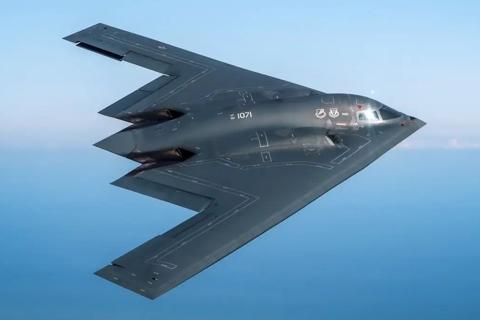
The Northrop Grumman B-21 Raider is a stealth strategic bomber in development for the United States Air Force, intended to replace the B-1 and B-2 and to carry both conventional and nuclear weapons. It first flew on 10 November 2023 and is planned to reach Ellsworth Air Force Base in 2027, but almost every specification remains classified - the Air Force has published a cost and a fleet size, and essentially nothing else. Developed by Northrop Grumman.
The Northrop Grumman B-21 Raider is a stealth strategic bomber in development for the United States Air Force, intended to replace the B-1 and B-2 and to carry both conventional and nuclear weapons. Developed by Northrop Grumman.
 Photo: Staff Sgt. Jeremy Mosier, United States Air Force, USAF / US DoD photo (public domain)
See Specifications for full detail.
The Northrop Grumman B-21 Raider is a stealth strategic bomber being developed for the United States Air Force, designed to penetrate defended airspace and deliver conventional or nuclear weapons. It was rolled out at Palmdale, California on 2 December 2022 and first flew on 10 November 2023.[1][2]
It is the first American bomber programme since the B-2, and it is being run with markedly more secrecy: the Air Force publishes an average unit cost and a minimum fleet size of 100 aircraft, and no dimensions, weights, performance or propulsion figures at all. The first operational aircraft are planned for Ellsworth Air Force Base in 2027.[2][3]
The Long Range Strike Bomber programme began as a classified effort in 2011, replacing the cancelled Next-Generation Bomber and responding to a problem the existing fleet could not solve: the B-2 numbered only 20 aircraft, the B-1 was not stealthy, and air defences had improved considerably since both were designed. A request for proposals went out in July 2014, and in October 2015 Northrop Grumman won the development contract against a joint Boeing and Lockheed Martin bid.[1][2]
The losing team protested, and the Government Accountability Office upheld the award, finding that cost had been the deciding factor between two technically acceptable proposals.[1] That framing has shaped the programme since: the Air Force has repeatedly presented the B-21 as an exercise in affordability and schedule discipline as much as capability, in explicit contrast to the B-2, which was cut from 132 aircraft to 21 as its unit cost climbed.
The aircraft is a flying wing, visibly related to the B-2 but smaller, and the Air Force describes it as a 'dual-capable penetrating strike stealth bomber capable of delivering both conventional and nuclear munitions', able to employ 'a broad mix of stand-off and direct-attack munitions'.[2] It is being built around an open systems architecture, which the service says is intended to reduce integration risk and enable competition - in practice, to allow sensors, processors and weapons interfaces to be replaced by whichever supplier wins a later contract rather than locking the fleet to its original vendor for forty years.[4]
Northrop has also leaned heavily on digital engineering, including a cloud-based digital twin used to support operations and sustainment, and the programme runs with around 8,000 staff and more than 400 suppliers across at least 40 states.[1] On crewing, the official position is deliberately open: the fact sheet says only that the aircraft is 'designed to accommodate manned or unmanned operations', and the Air Force has never confirmed a crew size.[2]
Almost everything a reader would normally expect from an aircraft entry is unavailable. The Air Force's own fact sheet carries no dimensions, no weights, no speed, no range, no ceiling, no engine designation and no crew figure. The only numbers it publishes are an average unit procurement cost - $550 million in 2010 dollars, $639 million in 2019 dollars, $692 million in 2022 dollars - and a minimum inventory objective of 100 aircraft.[2][4] Figures for wingspan, weight and thrust circulate widely in the aviation press and in reference works, but they are analysts' estimates rather than released data, which is why this entry records them as unknown rather than repeating them.
The secrecy has been contested. In 2016 Senator John McCain sought to force public disclosure of the programme's cost, and the provision was removed from the final conference report of the 2017 National Defense Authorization Act.[1] What the Air Force does publish - a per-aircraft cost, and a projected $203 billion to develop, procure and operate at least 100 aircraft over 30 years - is enough to argue about the programme's affordability while revealing nothing about what the aircraft can do.
The aircraft under test are not prototypes. Northrop states that the B-21 test article carries mission systems and was built by the same technicians using the same processes and tooling as production aircraft[5] - a deliberate departure from the usual pattern of hand-built prototypes that must be re-engineered for manufacture, and the reason testing and low-rate production have been able to overlap. The first aircraft was unveiled at Palmdale on 2 December 2022 and flew on 10 November 2023, moving to Edwards Air Force Base for testing with the 412th Test Wing and the Raider Combined Test Force. A second aircraft made its first flight on 11 September 2025, and by mid-2026 two were flying at Edwards, which allowed the programme to expand from airworthiness work into mission-systems and weapons-integration testing. The Air Force confirmed aerial refuelling with KC-135 tankers in April 2026.[1][6]
The programme has also inverted the usual test sequence. On 11 June 2026 an operational test pilot flew the aircraft alongside a developmental test pilot - normally operational crews only get an aircraft once developmental testing has validated the design. Colonel Matt Guasco noted the Air Force 'had not done this so early in a modern test program', the intent being to surface crew-interface, maintenance and weapons-employment problems before production rates climb rather than after.[6]
Low-rate initial production was authorised on 23 January 2024, and on 23 February 2026 the Department of the Air Force announced a 25 percent increase in annual production capacity, funded by $4.5 billion from fiscal 2025 reconciliation legislation. Secretary of the Air Force Troy Meink framed it as 'disciplined execution at the speed the security environment demands', and General Dale White said the decision reflected 'confidence in the program's performance and the stability of the industrial base'.[3]
Ellsworth Air Force Base in South Dakota was named the first main operating base and formal training unit in 2021, with Dyess in Texas and Whiteman in Missouri to follow, and Tinker in Oklahoma handling depot maintenance. Fielding at Ellsworth is projected for 2027.[2][3] The minimum inventory objective remains 100 aircraft, though studies have suggested numbers between 145 and 200 and the fleet size is still argued over.[1]
The B-21 is one of three legs of a simultaneous nuclear modernisation, alongside the LGM-35 Sentinel intercontinental missile and the Columbia-class submarine, and it is the only one of the three that also has a conventional job.[1] It is intended to replace both the B-1 and the B-2, which together are planned to leave service by around 2040 - a fleet the B-21 must be numerous enough to succeed, which is why the argument about whether 100 aircraft is sufficient matters more than it would for a supplementary type.
For now the aircraft exists in small numbers, flies from one base, and is described publicly in terms that carefully avoid saying what it can do. Whether the programme's central claim - that it can be delivered affordably and at scale, unlike the B-2 - holds up will not be clear until production rates and real fielding dates can be measured against the schedule. On present plans the first operational Raiders arrive in 2027.[3]
You will not track a B-21. The test fleet flies from Edwards AFB in restricted airspace with transponders off, and no B-21 has ever appeared on a public flight-tracking network. Photographs of the aircraft in flight come from spotters on public land near Edwards and Palmdale rather than from ADS-B.
| Performance | |
| Max Speed | ?? |
|---|---|
| Cruise SpeedCruise Speed — The economical speed an aircraft sustains for the bulk of a flight - lower than maximum speed, chosen for the best balance of time and fuel burn. Glossary → | ?? |
| RangeRange — How far an aircraft can fly without refuelling. Quoted figures vary with payload, speed and reserves - see also ferry range and combat radius. Glossary → | ?? |
| Service CeilingService Ceiling — The highest altitude at which an aircraft can still climb at a useful rate (typically 100 ft/min). Above it, the air is too thin to keep climbing meaningfully. Glossary → | ?? |
| Airframe & Weight | |
| Wingspan | ?? |
| Length | ?? |
| Height | ?? |
| WeightMTOW — Maximum Take-Off Weight - the heaviest an aircraft is certified to be at the start of its take-off run, including fuel, crew, payload and the aircraft itself. Glossary → | ?? |
| Power & Payload | |
| Engines | ?? |
| ArmamentArmament — The weapons an aircraft can carry: guns, missiles, bombs and rockets, whether mounted internally, on wing hardpoints, or in bomb bays. Glossary → | ?? |
| Crew | ?? |
| CapacityPayload — Everything an aircraft is carrying that isn't the aircraft or its fuel: passengers, cargo, or weapons. Payload and fuel usually trade off against each other. Glossary → | ?? |
| Program & Service | |
| Manufacturer | Northrop Grumman |
| Origin | United States |
| First Flight | November 10th 2023 |
| Service Entry | ?? |
| Number Built | ?? |
| Unit Cost | $692M average unit procurement cost (base year 2022 dollars; the same figure is published as $550M in 2010 dollars and $639M in 2019 dollars) - roughly $790M in 2026 dollars, adjusted for CPI inflation |
7 notable events involving the B-21 Raider, 2015 to 2026. Curated rather than exhaustive.
Northrop Grumman was awarded the engineering and manufacturing development contract for the LRS-B, beating a joint Boeing and Lockheed Martin bid. The losing team protested; the Government Accountability Office upheld the award, finding cost had been the deciding factor between two technically acceptable proposals.
The first B-21 was unveiled at Northrop Grumman's Palmdale facility in California, the first new American bomber shown publicly since the B-2 in 1988. Only the front of the aircraft was displayed, and no specifications were released.
The first B-21 flew from Palmdale to Edwards Air Force Base, entering the flight test programme with the 412th Test Wing and the Raider Combined Test Force.
The Air Force awarded the low-rate initial production contract, moving the programme from development into manufacturing while flight testing continued.
The second B-21 made its first flight, allowing the test programme to run airworthiness and mission-systems work in parallel rather than in sequence.
The Department of the Air Force announced a 25 percent increase in annual B-21 production capacity, funded by $4.5 billion from fiscal 2025 reconciliation legislation, with fielding at Ellsworth Air Force Base projected for 2027.
An operational test pilot flew the B-21 alongside a developmental test pilot at Edwards, unusually early in a modern bomber programme. The aim was to expose crew-interface, maintenance and weapons-employment issues before production rates increased.
| B-21 Raider | The only version announced. Northrop Grumman received the engineering and manufacturing development contract on 27 October 2015 and the aircraft has been developed under a single designation since, with no sub-variants disclosed. The Air Force describes it as a dual-capable penetrating strike bomber carrying both conventional and nuclear weapons, built around an open systems architecture intended to let subsystems be replaced competitively rather than locking the fleet to one supplier for decades. |
Source: Simple Flying - Antonio Di Trapani
Source: Simple Flying - Luke Diaz
Numbered as cited in the Overview article. Click a reference to see where it's used.
Additional reading you might find interesting...
PlanesDB entries are living documents - this is how this one has evolved, and who helped make it happen. Spotted something out of date? Help update it.