

The world's first operational stealth aircraft. Its bizarre faceted shape - a consequence of 1970s computing limits that could only calculate radar reflections from flat panels - made it nearly invisible to radar despite being aerodynamically unstable in every axis. Developed by Lockheed (Skunk Works).
The world's first operational stealth aircraft. Developed by Lockheed (Skunk Works).
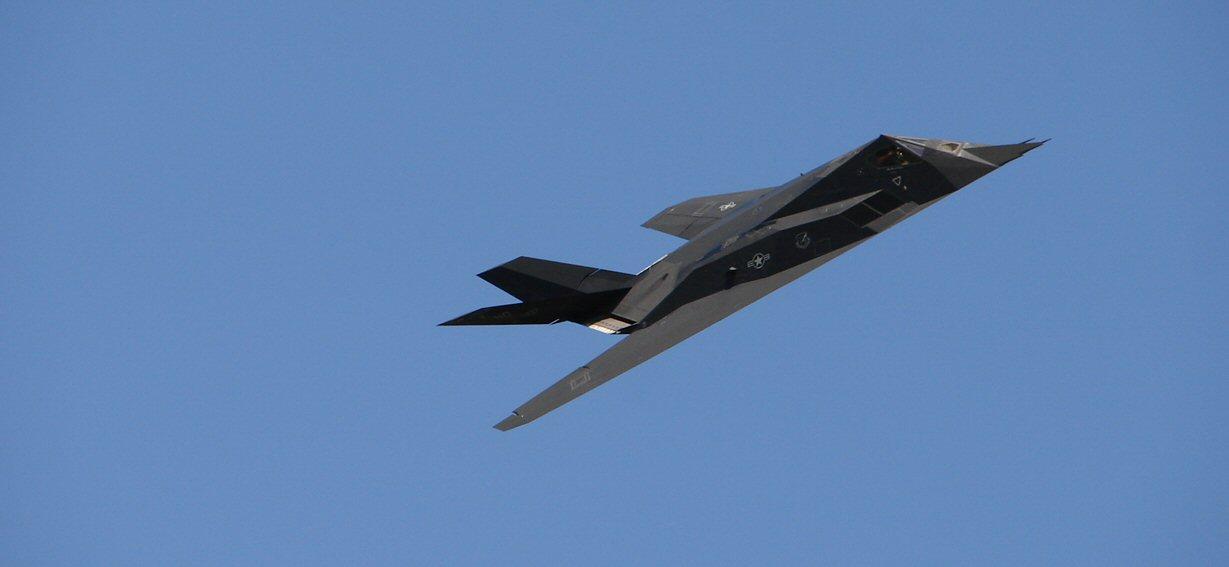
See Specifications for full detail.
The Lockheed F-117 Nighthawk was the world's first operational aircraft designed from the outset around stealth. Developed in near-total secrecy by Lockheed's Skunk Works, it flew in 1981, entered secret service in 1983, and was not even acknowledged to exist until 1988.[1] Its faceted, otherworldly shape - a direct consequence of what 1970s computers could and couldn't calculate - let it slip through the densest air defences on Earth and drop laser-guided bombs with then-unheard-of precision.[2]
Sixty-four were built. They opened the Gulf War over downtown Baghdad, suffered the only combat loss of a stealth aircraft in history over Serbia in 1999, fired the first shots of the 2003 invasion of Iraq - and then refused to properly retire, still flying classified test and training missions over the American southwest nearly two decades after their official farewell ceremony.[3]
The F-117 owes its existence to a piece of mathematics its adversary gave away for free. In 1964 the Soviet physicist Pyotr Ufimtsev published 'Method of Edge Waves in the Physical Theory of Diffraction', a dense academic paper showing that the strength of an object's radar return is governed by the configuration of its edges, not by its size. Moscow saw no military value in it and allowed it to be translated and published openly. A decade later, Lockheed radar specialist Denys Overholser found it, and realised it was the recipe for an aircraft that radar effectively could not see.[4][2]
Overholser and veteran Skunk Works mathematician Bill Schroeder distilled Ufimtsev's work into ECHO-1, a computer program that could predict the radar reflection of a shape - provided that shape was built entirely from flat panels, because 1970s computing power could not handle curves. The design study that emerged in 1975 was so aggressively un-aerodynamic that Skunk Works engineers nicknamed it the 'Hopeless Diamond'.[5][6]
The concept won DARPA's Experimental Survivable Testbed competition, and in 1976 Lockheed was contracted to build two sub-scale demonstrators under the code name Have Blue - assembled for roughly $35 million for the pair using parts raided from other aircraft: T-38 engines, F-16 fly-by-wire components, A-10 landing gear.[7] The first flew at Groom Lake on 1 December 1977. Both demonstrators were eventually lost in test accidents, but the data they returned settled the argument: faceted stealth worked.[7]
The two demonstrators, HB1001 and HB1002, were roughly 60% the size of the eventual F-117 and assembled largely from other programmes' parts: a pair of non-afterburning General Electric J85 turbojets, Northrop F-5 main landing gear, and an F-16 quadruple-redundant fly-by-wire system adapted to hold an aerodynamically unstable airframe straight. Both were lost in testing - HB1001 pitched up on landing in May 1978 with its gear jammed half-retracted, and HB1002 suffered a hydraulic-line fire in July 1979; both pilots ejected, and neither loss was made public for years. The data they returned first shaped the production aircraft's shallower wing sweep and outward-canted fins.[7]
Full-scale development was approved on 1 November 1978 under the program name Senior Trend, led by Skunk Works chief Ben Rich. Just 31 months later, on 18 June 1981, the first YF-117A lifted off from Groom Lake, Nevada - an airfield the U.S. government wouldn't formally acknowledge for another three decades.[8][9]
Five test aircraft and 59 production jets followed, the last delivered on 3 July 1990.[2] The type reached initial operating capability in October 1983 with the 4450th Tactical Group at Tonopah Test Range - and then simply vanished into its own cover story. On paper the unit flew A-7 Corsairs. Pilots commuted from Las Vegas by weekly charter flight, told their families they flew utility jets, and flew the Black Jet only at night, inside a security bubble unmatched since the Manhattan Project.[10]
Secrecy had a body count. Two pilots died in nighttime crashes in 1986 and 1987 that the Air Force could not honestly explain, cordoning off the wreckage of aircraft that did not officially exist.[11] By late 1988 the program was too big to hide, and on 10 November the Pentagon released a single deliberately unflattering photograph, ending a decade of 'F-19' speculation. The fleet moved in daylight to Holloman AFB, New Mexico, in 1992.[1]
Five YF-117A development aircraft, 780 to 784, bridged proof of concept to weapon system. The first flew on 18 June 1981 and immediately exposed handling problems that forced further fly-by-wire revision; 780 and 781 stayed aerodynamic testbeds while 782 to 784, crewed by the self-styled "Baja Scorpions", carried full mission avionics. Wing sweep came back from Have Blue's 72.5 degrees to 67.5 and the tail fins moved from an inward tilt to the outward cant every later Nighthawk carried. The first production airframe, 785, crashed on take-off on 20 April 1982, badly injuring Lockheed test pilot Bob Riedenauer.[2]
Every strange line of the F-117 is a radar decision wearing an airplane costume. Flat facets scatter more than 99% of incoming radar energy away from its source, giving a radar cross-section of roughly 0.001 square metres - the signature of a small ball bearing on a scope, carried by a 20-metre-long bomber.[2][12] Nearly a ton of radar-absorbent material was glued over the airframe, applied with a putty crews affectionately called 'butter'.[2]
The aerodynamic price was severe: the F-117 is unstable in pitch, roll and yaw simultaneously, and is only flyable at all through quadruple-redundant fly-by-wire controls adapted from the F-16 - earning the early nickname 'Wobblin' Goblin', which its pilots insist it never deserved.[2] Two General Electric F404 turbofans, deliberately fitted without afterburners, exhaust through narrow 'platypus' slots that mix hot gases with cold air to smother the jet's infrared signature.[12]
Just as remarkable is what the 'fighter' lacks: no radar (a radar is a beacon), no gun, no air-to-air weapons, and firmly subsonic speed. Navigation and attack ran through inertial guidance and two internal infrared sensor turrets with laser designators, feeding avionics borrowed from the F-16, F/A-18 and B-52.[2] Two internal bays carried up to 5,000 lb of ordnance - classically a pair of 2,000 lb laser-guided bombs.[12]
Even the name is a piece of misdirection. Project chief Alan Brown recalled that General Robert J. Dixon reasoned the elite pilots the program needed would be easier to recruit to an 'F-for-fighter' than an 'A-for-attack' jet, and '117' simply followed the radio call-sign conventions used for classified aircraft over Nevada - when Lockheed printed 'F-117A' on the cover of the first flight manual, the designation stuck.[2] Saudi crews in 1991 gave it a better name: 'Shaba' - ghost.
Behind the faceting sat a conventional strike fit: forward- and downward-looking infrared turrets with a laser designator, an IBM navigation and attack computer, and two internal bays cleared for laser-guided bombs up to 2,000 lb. The 59 production aircraft were organised into three squadrons of the 4450th Tactical Group at Tonopah, the second and third standing up in July 1983 and October 1985, before the fleet moved to the 49th Fighter Wing at Holloman in 1992.[10]
The Nighthawk's combat debut was modest: during the December 1989 invasion of Panama, two F-117s dropped bombs beside a barracks at Rio Hato as a stun-and-confuse measure - a mission whose muddled results drew as much criticism as praise.[13][14]
Its defining hour came thirteen months later. On the opening night of Operation Desert Storm, F-117s were the only coalition aircraft sent against targets in downtown Baghdad - by most accounts the most heavily defended piece of sky in the world. Over 43 nights, 42 Nighthawks flew roughly 1,300 sorties against some 1,600 high-value targets, around 40% of the strategic target list, despite making up only about 2% of coalition strike aircraft - and came home without a scratch.[15][2] Wartime claims of 80% bombing accuracy were later revised down to 41-60% by postwar analysis, but the psychological effect was total: stealth had changed air war permanently.[2]
The campaign also produced the type's darkest night. On 13 February 1991, two F-117 laser-guided bombs pierced the Amiriyah shelter in Baghdad, which U.S. planners had assessed as a military command post; more than 400 civilians sheltering inside were killed.[2]
On 27 March 1999, during the Kosovo campaign, the myth of invisibility broke. A Serbian S-125 'Neva' battery of the 250th Air Defence Missile Brigade, commanded by Colonel Zoltan Dani, caught F-117 'Something Wicked' (call sign Vega 31) at the moment its bomb bay doors spoiled its stealth shaping, and put a 1960s-vintage missile into it from about 13 kilometres away. Pilot Lt Col Dale Zelko ejected and was pulled out by an Air Force pararescue team six hours later; the wreckage went to the Belgrade Aviation Museum, and reportedly onward - in samples - to Russia and China.[16][17] It remains the only stealth aircraft ever lost in combat.
The F-117 fired the opening shots of one more war: on 20 March 2003, two Nighthawks dropped bunker-busting EGBU-27s on the Dora Farms complex outside Baghdad in an attempt to kill Saddam Hussein in the war's first minutes. Intelligence later showed he had left hours earlier.[2]
In December 2005, Program Budget Decision 720 proposed retiring the fleet by October 2008, freeing an estimated $1.07 billion to buy more F-22 Raptors - the aircraft that had inherited its mission with twice the speed and none of the compromises.[2] The first six jets made their final flight on 12 March 2007 after a ceremony at Holloman, and the fleet stood down in waves until 22 April 2008.[18]
But the Nighthawks never went to the boneyard. Congress required that they be kept recallable, so most were placed in 'Type 1000' climate-controlled storage in their original hangars at Tonopah - wings removed, systems preserved - an honour extended to no other retired U.S. type.[2]
Then, quietly, they kept flying. Photographed over the Nevada and California ranges year after year, the jets serve as stealth targets for radar development and as low-observable 'red air' adversaries - the U.S. Air Force only formally acknowledged the flights in 2021, thirteen years after retirement.[3] Since then F-117s have appeared with experimental mirror-like coatings, deployed to Alaska for exercise Northern Edge in 2023, and were photographed refuelling from a KC-46 tanker over Los Angeles in 2025. Current plans call for demilitarising just two or three airframes a year until 2034 - meaning the fighter that retired in 2008 will have kept flying for a quarter-century afterwards.[3]
For its first decade the F-117 existed mostly as a rumour, and popular culture rushed to fill the vacuum. In 1986 the Testor Corporation released a sleek, curved 'F-19 Stealth Fighter' model kit that became one of the best-selling plastic kits in history and prompted questions in Congress about how a $9.95 toy had apparently scooped the Pentagon's biggest secret - despite looking nothing whatsoever like the real jet.[19][20] Tom Clancy flew a fictional 'F-19A Ghostrider' in Red Storm Rising, and MicroProse turned the phantom into the definitive flight simulators F-19 Stealth Fighter and, once the truth was out, F-117A Nighthawk Stealth Fighter 2.0 - for a generation of PC pilots, the Black Jet was their first cockpit.[21]
The 1999 shootdown produced one of aviation's great codas. In 2011, Dale Zelko travelled to Serbia to meet Zoltan Dani - by then a village baker - and the two men, later joined by their families, became genuine friends. Their reconciliation is the subject of the 2013 documentary The Second Meeting.[22][23]
The Nighthawk's deeper legacy is airborne everywhere today: the B-2, F-22, F-35 and every stealth aircraft since flies on lessons the faceted jet proved over Baghdad. Fifteen airframes are now on public display across the United States - and one, in pieces, in Belgrade. See the Survivors tab to find the one nearest you.
Unfortunately, you won’t find the F-117 Nighthawk here. It has no civil ADS-B transponder to broadcast from, and the handful of sorties it still flies are classified test and adversary-training missions that don't publish a position for consumer trackers to pick up.
| Performance | |
| Max Speed | 536 kn (617 mph / 993 km/h) |
|---|---|
| Cruise SpeedCruise Speed — The economical speed an aircraft sustains for the bulk of a flight - lower than maximum speed, chosen for the best balance of time and fuel burn. Glossary → | 560 mph |
| RangeRange — How far an aircraft can fly without refuelling. Quoted figures vary with payload, speed and reserves - see also ferry range and combat radius. Glossary → | 1,070 mi unrefuelled combat mission |
| Service CeilingService Ceiling — The highest altitude at which an aircraft can still climb at a useful rate (typically 100 ft/min). Above it, the air is too thin to keep climbing meaningfully. Glossary → | 45,000 ft |
| Airframe & Weight | |
| Wingspan | 43 ft 4 in |
| Length | 65 ft 11 in |
| Height | 12 ft 5 in |
| WeightMTOW — Maximum Take-Off Weight - the heaviest an aircraft is certified to be at the start of its take-off run, including fuel, crew, payload and the aircraft itself. Glossary → | empty: 29,500 lb; MTOW: 52,500 lb |
| Power & Payload | |
| Engines | 2 × General Electric F404-F1D2 non-afterburning turbofans (10,600 lbf each) |
| ArmamentArmament — The weapons an aircraft can carry: guns, missiles, bombs and rockets, whether mounted internally, on wing hardpoints, or in bomb bays. Glossary → | GBU-10/GBU-27 Paveway laser-guided bombs; B61 nuclear capability (never used) |
| Crew | 1 |
| CapacityPayload — Everything an aircraft is carrying that isn't the aircraft or its fuel: passengers, cargo, or weapons. Payload and fuel usually trade off against each other. Glossary → | 2 × 2,000 lb laser-guided bombs in internal bays |
| Program & Service | |
| Manufacturer | Lockheed (Skunk Works) |
| Origin | United States |
| First Flight | June 18th 1981 |
| Service Entry | October 15th 1983 |
| Retired | April 22nd 2008 |
| Number Built | 64 |
| Unit Cost | $42.6M flyaway unit cost (1990 dollars) - roughly $109M in 2026 dollars, adjusted for CPI inflation; program totalled $6.56B including R&D |
| Combat Losses | 1 of 64 built - 82-0806 "Something Wicked", shot down over Serbia on 27 Mar 1999, the only stealth aircraft ever lost in combat. 6 further airframes were lost in training/test accidents between 1982 and 1997. |
5 notable events involving the F-117 Nighthawk, 1986 to 1999, accounting for 3 deaths. Curated rather than exhaustive.
An F-117A crashed near Bakersfield, California after the pilot became spatially disoriented and flew into terrain, killing him.
Major Michael C. Stewart was killed when his F-117A came down on the Nellis range at night. The programme was still secret, so the Air Force could confirm little beyond the pilot's name - the second fatal loss in fifteen months.
An F-117A suffered an uncommanded roll and caught fire shortly after takeoff near Holloman Air Force Base, New Mexico, and crashed, killing the pilot.
An F-117A broke apart in flight near Baltimore, Maryland, en route to an air show, after a support-assembly structural failure caused by missing fasteners. The pilot ejected safely.
An F-117A was hit by a Serbian surface-to-air missile near Novi Sad while returning from a bombing mission near Belgrade — the only stealth aircraft ever shot down in combat. The pilot ejected and was rescued within about six hours.
| Have Blue | Two sub-scale proof-of-concept demonstrators flown 1977-79, both lost in accidents. |
| YF-117A | Five full-scale development aircraft. |
| F-117A | 59 production aircraft flown by the 4450th Tactical Group and later the 49th Fighter Wing. |
Of 64 Nighthawks built, most still sit wings-off in climate-controlled storage at Tonopah - but these airframes are on public display. Serials in the 79-10xxx range are YF-117A test aircraft; the rest are production jets, listed with the nose art names they carried in service.
Source: AeroNewsJournal
Source: 19FortyFive
Source: Army Recognition
Source: The Aviationist
Numbered as cited in the Overview article. Click a reference to see where it's used.
Additional reading you might find interesting...
PlanesDB entries are living documents - this is how this one has evolved, and who helped make it happen. Spotted something out of date? Help update it.


